Every Reykjavik Golden Circle Stop in Order, and What You See at Each
The short answer. The classic order is Þingvellir, then Geysir, then Gullfoss, with Kerið on the way back. Many people see them from the window of a Reykjavik Golden Circle bus tour, and many days add a bakery town, a waterfall, a greenhouse farm or a bath. The whole loop costs nothing to enter except Kerið and the baths.
The loop at a glance
| Stop | What it is | Tours give it | Costs |
|---|---|---|---|
| Þingvellir | The rift valley and the old assembly ground | 30 minutes to 1 hour | Nothing on a tour |
| Geysir | The geothermal field and Strokkur | 30 minutes to 1 hour 30 | Nothing |
| Gullfoss | The two-step falls and canyon | 30 minutes to 1 hour | Nothing |
| Kerið | A red crater with a lake | 20 minutes to 45 minutes | 700 ISK, often in the fare |
| Brúarfoss | A waterfall off road 37 | 30 minutes | 750 ISK parking, by car |
| Friðheimar | A tomato greenhouse farm | 1 hour to 1 hour 30 | Lunch if you eat |
Order varies. Some tours start at the crater, some reverse the whole loop to avoid the crowds, and the order can change on the day for weather. The sequence below is the most common one.
Þingvellir: the rift and the assembly
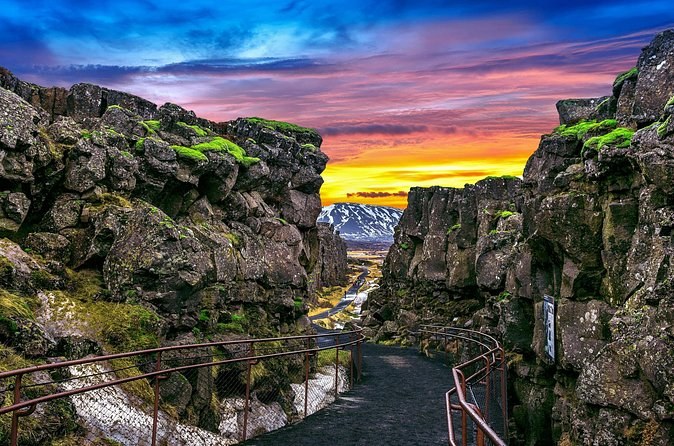
The first stop is the one with the most history. The Alþingi, an open-air assembly for all of Iceland, was founded here around 930 and met until 1798, for two weeks a year. The remains of around 50 booths of turf and stone survive, and the park has been a UNESCO World Heritage Site since 2004. It is also a rift valley, a graben seven kilometres wide on a floor of 10,000-year-old lava.
The usual walk starts at Hakið, the visitor centre on the lip of the rift, and goes down the Almannagjá gorge between the lava walls. The ledge where the assembly opened is the Law Rock, Lögberg, usually marked by a flagpole. Longer stops reach Öxarárfoss, the waterfall the sagas say was diverted into the gorge, and give you a view of Þingvallavatn, the country’s largest natural lake. The national park page walks the route in full.
If your stop is long enough, the Heart of Iceland exhibition at Hakið takes about 40 minutes and costs 1,200 ISK for adults, with under-18s free. It is the quickest way to make sense of the rift before you walk into it.
Do not miss: the view from the top of the gorge before you walk down. Paul_H’s guide dropped the group at the top and collected it at the bottom, which is the easy way to walk it.
Geysir and Strokkur: the field that named the rest
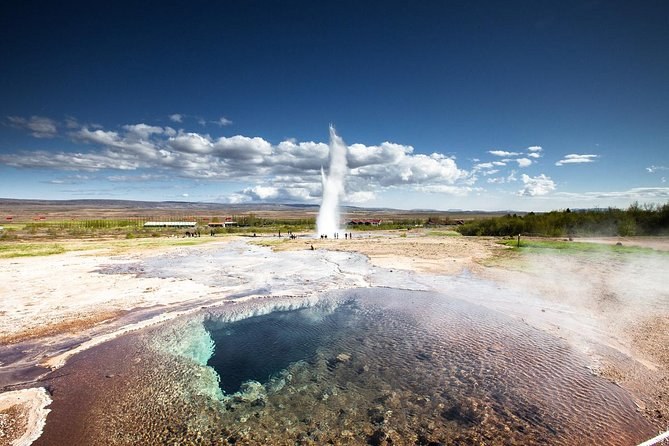
The Geysir field in Haukadalur gave every geyser in the world its name. The great Geysir itself has been erratic for a long time and last erupted in 2016. Strokkur, a few steps away, is the one you will see: it erupts every few minutes, as high as 30 metres. Watch the pool: it swells into a blue dome just before it goes.
The high-temperature area covers about 3 square kilometres, and the protected natural monument at its heart, 1.2 square kilometres, has been protected since 17 June 2020. The rules are simple and enforced: stay on the marked paths, throw nothing into the springs, and never bathe in them. This is usually the lunch stop, and tours give it 30 minutes to 1 hour 30. Jon_V puts it well: the geyser rewards patience.
Gullfoss: two drops into a canyon
About ten minutes’ drive on, the river Hvítá drops twice at Gullfoss, 11 metres and then 20 metres, into a canyon about 2.5 km long and 70 metres deep. On an average day about 109 cubic metres of water a second go over; in summer it is about 130. The spray reaches the viewpoints, so a waterproof layer helps. The falls have been protected since 1979, and drones need a permit.
Kerið: the crater with a lake
Kerið is on private land and is the one stop that charges entry: 700 ISK, which covers the paths round the rim, free parking and toilets. The crater is about 6,500 years old, about 55 metres deep and 270 metres across. You can walk the rim or take the path down to the water. Many fares include the fee; on the coach from Bus Stop 12, only morning departures stop here. The owners publish no hours. Their site says only that the crater is open when the sun is shining.
The stops some days add
- Hveragerði. A geothermal town with a bakery, where the classic minibus makes its first stop of the day.
- Brúarfoss. A waterfall reached from road 37, with a pay car park at 750 ISK; one minibus day gives it 30 minutes.
- Friðheimar. A tomato greenhouse where the restaurant serves soup among the plants, 11:30 to 16:00, and a horse show runs for groups in summer.
- Faxi. A waterfall the private highlights day adds between the crater and the geysers, with its parking fee in the fare.
- A horse farm. The horse-farm coach gives you 30 minutes to meet and feed Icelandic horses.
The lakeside town and the bath
Some days pass Laugarvatn, a village by a lake of the same name in a geothermal area, where steam from the ground is used to bake rye bread. The Fontana spa there reopened after a full renovation on 1 August 2026 and runs geothermal bakery tours. If you are staying out of the city, it is also a base; where to stay compares the towns.
The other bath on the loop is the Secret Lagoon at Flúðir, built in 1891 and the oldest swimming pool in Iceland. Tours that end there give you an hour to 90 minutes in the water. If you arrive by car, adult entry is 4,500 ISK, and the pool is open every day from 10:00, until 19:00 in winter and 20:00 in summer. You bring a swimsuit either way.
Hidden things most people walk past
- The small pools beside Strokkur carry names of their own: Konungshver, Blesi and Litli Geysir among them.
- The lake at Þingvellir is fed mostly underground: about 90% of its water arrives through the lava, 20 to 30 years after it fell as snow on Langjökull.
- The river at the assembly ground was, according to the sagas, moved into the gorge to give the assembly water.
- The crater shows three colours at once: red volcanic rock, moss and light blue water.
Photographs, light and the order to go
For photographs, the sun matters more than the order. Gullfoss can throw a rainbow into its spray on a sunny day. Strokkur looks best side-lit, with the dark ground behind the white column. In December the light lasts about four hours, so every stop is shot in a low sun; in June you have about 21 hours to play with.
If you drive yourself, run the loop against the flow. One superjeep day reverses the circle to escape the crowds, and a car can do the same. The map shows the loop and the drive times between each stop, and things to do lists every stop with the minutes tours give it.
Want a guide to explain it?
A guide makes most sense at Þingvellir, where the rift and the assembly are hard to read without one. The coach from Bus Stop 12 is the lowest fare that brings one; the classic minibus adds a smaller group and the crater fee. When to visit helps you choose the month.
Tours that add a stop to the loop
Golden Circle, Fridheimar Farm & Horses Small Group Tour from Reykjavik
Nine hours with 90 minutes at the tomato greenhouse and its horse show, plus the crater, the falls, the park and the geysers; 22 at most.
From $130 per person
Check Availability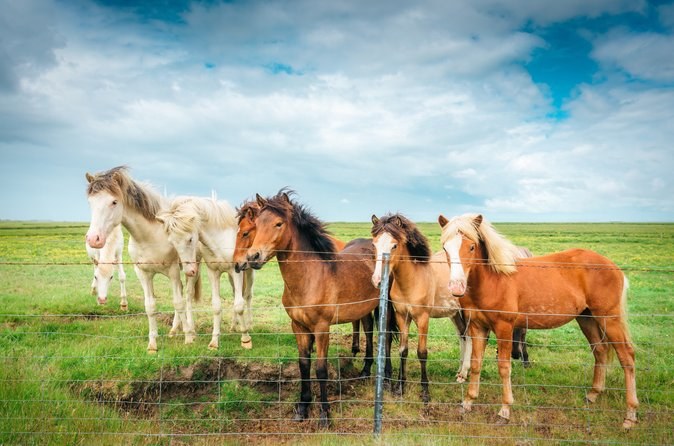
Golden Circle Tour & Meet the Icelandic Horses from Reykjavik
Eight hours on a coach with a toilet and Wi-Fi, with 30 minutes at a horse farm where you feed the horses, and the crater fee included.
From $95 per person
Check Availability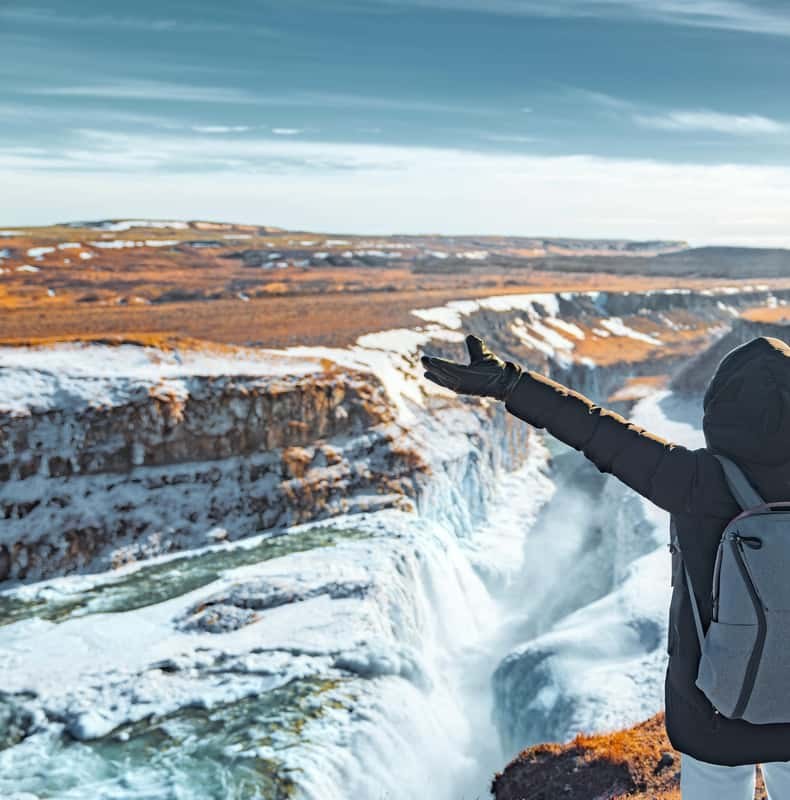
Reykjavik: Golden Circle&Horsefarm in Chinese冰岛黄金圈与马场参观中文一日团
Ten hours guided in Chinese, with a waterfall stop and the crater added to the three sights, and tea and hot water on board.
From $86 per person
Check AvailabilityNext: read the stories behind the stops in fifteen facts about the loop. Every fare sits side by side on Reykjavik Golden Circle Tours.