15 Reykjavik Golden Circle Facts That Will Surprise You
The short answer. The Golden Circle is three stops most people see in a day on a Golden Circle tour from Reykjavik. What the day rarely explains is that the parliament met here for nearly 870 years, the geyser you came to see has been quiet since 2016, and the plates you are told to stand between are several kilometres apart. Here are fifteen facts worth knowing before you go.
The assembly ground
1. A parliament met in the rift for nearly 870 years
The Alþingi, an open-air assembly for the whole country, was founded at Þingvellir around 930 and kept meeting there until 1798. It met for two weeks a year, set laws and settled disputes, and what survives are fragments of around 50 booths of turf and stone. Most of what you see on the walk is the landscape the assembly chose, not buildings.
2. The law was spoken from a rock nobody can pin down
The Lawspeaker recited the law from Lögberg, the Law Rock, where the assembly opened and closed. Its exact site is debated; the ledge with the flagpole is the usual answer. Stand there and you are where the assembly heard its law, whichever rock it was.
3. Christianity and independence were both decided here
Iceland adopted Christianity at the assembly in 1000, and independence was declared at Lögberg in 1944. Few places in the country carry more of its history, which is why Icelanders treat the ground with care and ask you to keep to the paths.
4. The park is older than the country’s independence
Þingvellir became a national park in 1930, after protection by law in 1928, and was inscribed as a UNESCO World Heritage Site in 2004. The listed property covers 9,270 hectares, and it was inscribed for the assembly, not for the geology.
The rift and the lake
5. You cannot touch both continents
You will hear that you can. The park says otherwise: the North American plate and the microplate to the east are about 5 km apart, and the valley between them is a rift zone, not a line. Silfra, the fissure snorkellers swim, sits inside that zone, and it was not formed in 1789 either, another story the park corrects.
6. The rift is seven kilometres wide
What you walk through is a graben, a valley dropped between faults: the Almannagjá gorge on the west and another fault on the east, seven kilometres apart, on lava about 10,000 years old.
7. The lake is filled from underground
Þingvallavatn is Iceland’s largest natural lake, about 84 square kilometres and 114 metres deep at its deepest. About 90% of the water reaches it underground, through the lava, and takes 20 to 30 years to arrive from the Langjökull glacier.
8. The snorkelling water stays at 2 to 4 °C
That is its temperature all year, and the rules are strict: never enter alone, never enter caves, and snorkel with a buddy. Divers go no deeper than 18 metres and need a drysuit certificate or ten logged drysuit dives. The reward is clear water you can see a long way through.
The geysers
9. Every geyser in the world is named after this one
The name Geysir gave geysers their name in other languages. The field around it covers about 3 square kilometres, and its other springs have names of their own: Konungshver, Blesi and Litli Geysir among them. You pass several on the path to Strokkur.
10. The famous one has been quiet since 2016
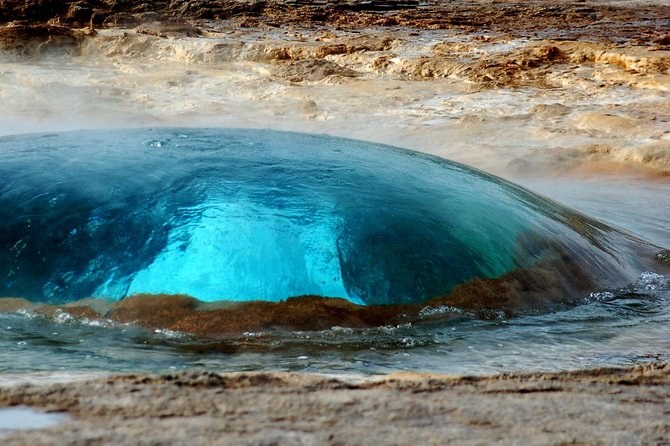
Geysir itself is erratic and last erupted in 2016. The column you see is Strokkur, which erupts every few minutes and as high as 30 metres. Strokkur became the main draw because Geysir went quiet.
11. You may bake bread in a spring, and nothing else
Since the field became a protected natural monument on 17 June 2020, cooking in the springs is banned, with one exception: the traditional baking of bread in the ground. The protected monument covers 1.2 square kilometres, and throwing anything into a spring, even a coin, is against the rules.
The falls and the crater
12. Gullfoss is two waterfalls
The upper drop is 11 metres, the lower 20, and together they pour into a canyon about 2.5 km long and 70 metres deep. The falls sit 190 metres above sea level, and the canyon was likely cut slowly since the ice age rather than by one flood, the Environment Agency says.
13. It can carry nearly twenty times its usual flow
An average of 109 cubic metres a second goes over the falls, about 130 in summer. The largest floods on record reached 2,000. The falls were protected in 1979 so that the water and the canyon would stay as they are, open to anyone who walks up.
14. The crater has no opening hours
Kerið is about 6,500 years old and 55 metres deep, and it is on private land, so it charges 700 ISK. Its owners publish no hours. Their site says only that the crater is open when the sun is shining. It is 170 metres wide and 270 across, and its owners call it one of the three most recognizable volcanic craters in Iceland.
15. The oldest pool in the country is on the loop
The Secret Lagoon at Flúðir was built in 1891 at Hverahólmi and is the oldest swimming pool in Iceland. A few tours finish there, with the ticket in the fare. On your own, adult entry is 4,500 ISK, and the pool opens every day at 10:00.
The facts in one table
| Fact | Figure | Source |
|---|---|---|
| Assembly founded | Around 930 | The national park; UNESCO |
| Assembly last met | 1798 | The national park |
| UNESCO inscription | 2004 | UNESCO |
| Geysir's last eruption | 2016 | Environment Agency |
| Strokkur's height | up to 30 metres | Environment Agency |
| Gullfoss drops | 11 and 20 metres | Environment Agency |
| Kerið's age | about 6,500 years | The landowners |
| Secret Lagoon built | 1891 | The Secret Lagoon |
Where to see each fact for yourself
- The assembly and the Law Rock: walk down the gorge from Hakið to the flagpole.
- The rift: the top of the gorge at Hakið, before you walk down into it.
- The lake: Þingvallavatn, beside the assembly ground; the clear water of the snorkelling fissure is part of it.
- The geysers: Strokkur, and the quiet pool of the great Geysir beside it.
- The two drops: the paths above the falls at Gullfoss.
- The crater: walk the rim first, then go down to the water.
What the facts mean for your day
Three of these change how you spend the day. Because the plates are not a line you can straddle, the rift is best seen from the top of the gorge. Because Geysir is quiet, the time goes on Strokkur, and it is worth staying for more than one eruption. And because Kerið is on private land, fares differ on whether its fee is paid for you.
- The classic minibus includes the crater fee.
- The coach from Bus Stop 12 stops at the crater on morning departures.
- The Blue Lagoon day pays for both the crater and the lagoon.
Things to do covers every stop, the visitor guide covers fees and hours, and when to visit and the weather help you pick the month. If you want to see the rift from the water, the Silfra day is below.
Tours that tell the story on site
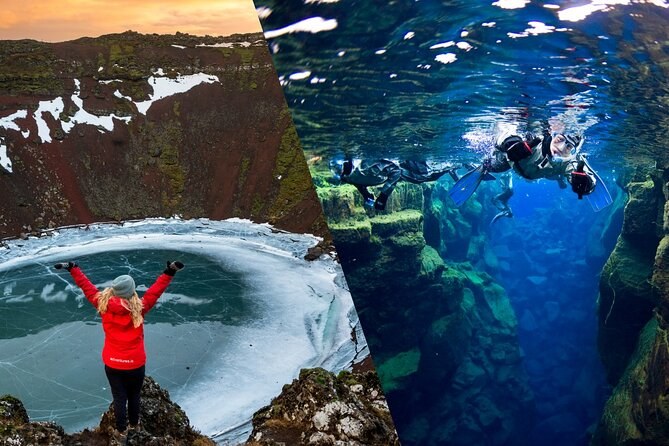
Golden Circle & Silfra Fissure Snorkeling Day Tour from Reykjavik
Nine hours: a snorkel in the rift in a drysuit with a certified guide, then the loop and the crater; from age 12, and you must swim.
From $296 per person
Check Availability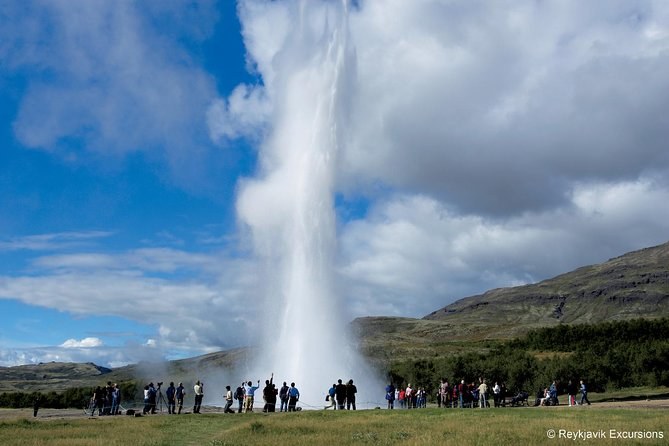
The Golden Circle Guided Bus Tour from Reykjavik
Six and a half hours from the BSÍ terminal with a live guide and an app audio guide in many languages; bring your own headphones.
From $88 per person
Check Availability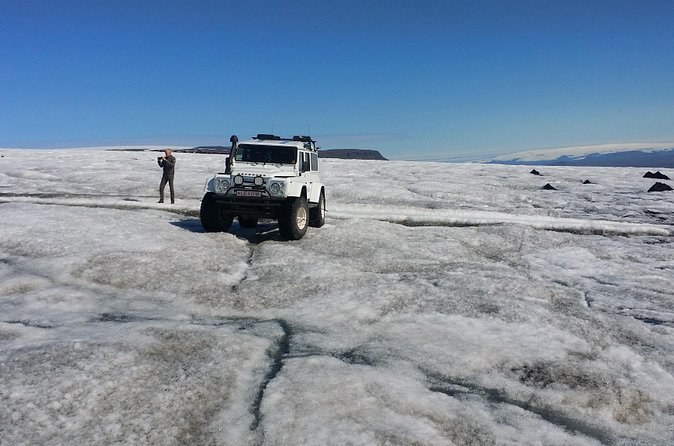
Golden Circle Small-Group Tour by Superjeep from Reykjavik
Eight hours in a modified superjeep on 40-inch wheels, ten at most, out towards the glacier; the loop's park fees are in the fare, a snowmobile ride is not.
From $340 per person (minimum 2)
Check AvailabilityNext: plan a family day in ages, hours and what works for children. Every fare sits side by side on Reykjavik Golden Circle Tours.